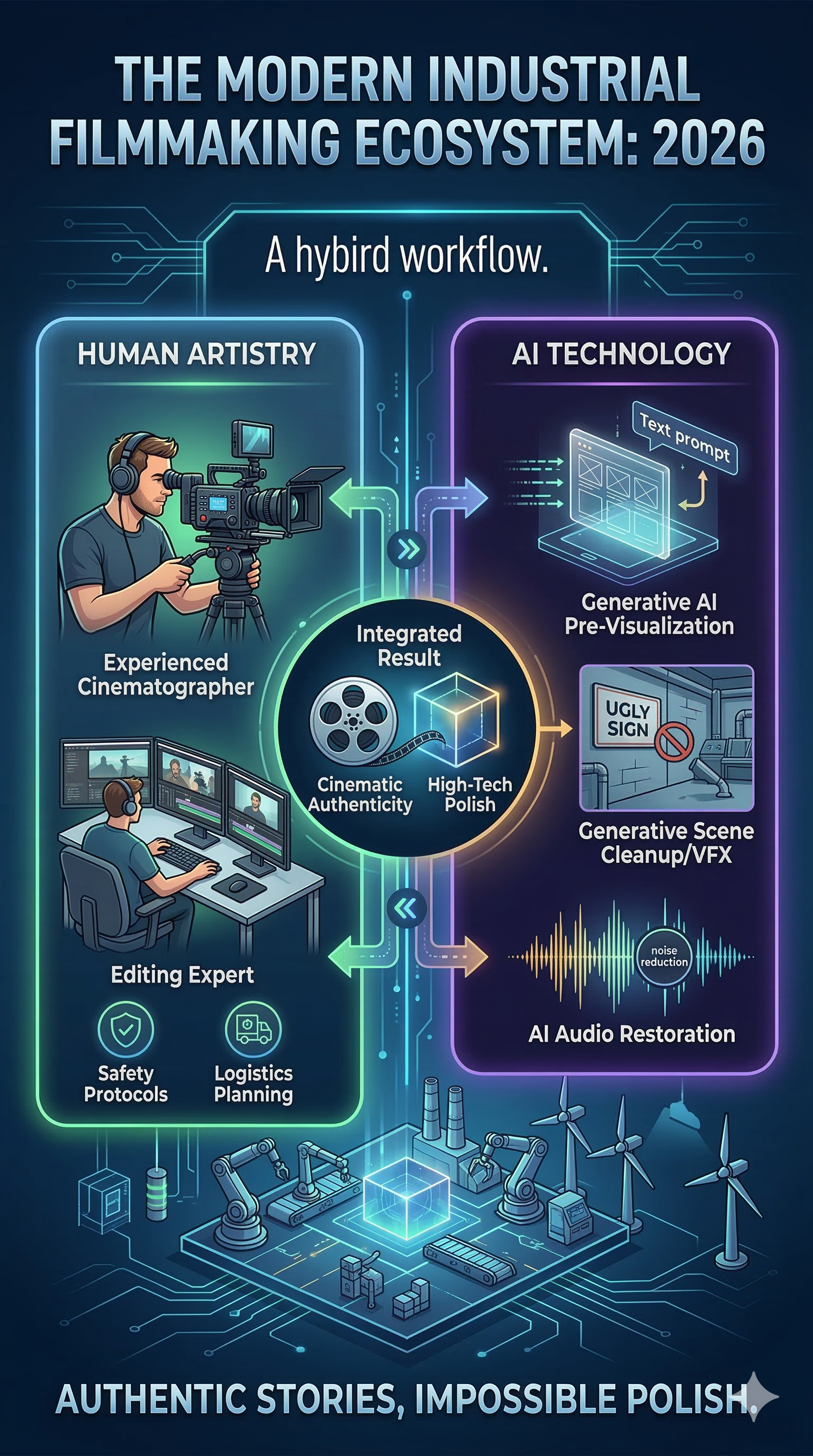
In 2026, the “secret sauce” of a high-end industrial corporate film is no longer just a fancy camera or a talented editor—it is a hybrid ecosystem. Industrial environments (factories, labs, construction sites) are inherently “messy” for traditional filmmaking. They have unpredictable lighting, loud noise, and complex machinery that is hard to explain.To solve this, the industry has shifted to a four-pillar model that balances human artistry with “brute force” technology.1. The Power Foundation: Good Camera Gear & OpticsHigh-end gear is about more than just “resolution.” In an industrial setting, the environment is often the enemy.Dynamic Range: Factories often have dark corners and bright, glowing sparks or molten metal. High-end sensors (like those in ARRI or RED cameras) capture both extremes without “blowing out” the image.Macro & Specialty Lenses: To make a microchip or a high-speed piston look “heroic,” you need glass that can focus inches away or capture 1,000 frames per second for smooth slow-motion.Ruggedness: Industrial shoots are dusty and hot. Pro gear is built to survive environments that would destroy consumer electronics.2. The Visionaries: Experienced CinematographersYou can give a novice a $50,000 camera, but they won’t know how to “light” a massive warehouse.Safety & Logistics: An experienced DP (Director of Photography) knows how to work around heavy machinery and “hot zones” without disrupting production.Visual Storytelling: They turn a boring assembly line into a rhythmic, cinematic sequence using specific angles (low-angle “power” shots) and lighting to create depth where there is only grey concrete.3. The Scalpel: AI Tools for Pre- and Post-ProductionAI has become the “assistant” that handles the grunt work, allowing the creative team to focus on the story.Pre-Visualization (Pre-viz): Before a single frame is shot, AI tools (like Runway or Luma) generate storyboards and 3D mockups. This ensures the client and the crew are on the same page.Generative Filling: If a factory wall has an ugly “No Smoking” sign or a scuffed floor that can’t be moved, AI can “clean” the environment in seconds—a task that used to take VFX artists days of rotoscoping.Virtual Environments: If a company wants to show a factory that isn’t built yet, AI-driven LED volumes (like those used in The Mandalorian) allow live actors to stand in a “digital twin” of the future facility.4. The Glue: Editing Experts & AI IntegrationThe editor is now a “prompt engineer” and a “narrative architect.”Audio Restoration: AI tools like Adobe Podcast or Descript can strip away the deafening roar of a hydraulic press while leaving a CEO’s voice sounding like it was recorded in a studio.Smart Trimming: AI can scan hours of raw “B-roll” of machines and automatically pick the shots with the most interesting motion or perfect focus, saving the editor 40% of their time.Color Grading Consistency: AI analyzes the “mood” of a global brand and automatically applies consistent color science across footage shot in different countries or lighting conditions.The Synergy TableComponentPrimary FunctionThe “AI” UpgradeCinematographerHuman emotion & safetyAI-assisted focus pulling & drone pathsCamera GearRaw data & light captureNeural sensors for low-light noise reductionEditingPacing & storytellingText-based editing & automated rough cutsAI ToolsEfficiency & VFXGenerative B-roll & “Digital Twin” backgroundsWhy this mix works: Without the AI, the film is too expensive and slow to produce. Without the Cinematographer and Gear, the film looks “uncanny” or “fake”—lacking the authentic grit and human connection that builds trust with B2B clients.
Experience the future of industrial storytelling—where precision gear meets AI-driven polish. Build your legacy with Cuts & Camera Productions today.
CALL NOW 7042111335, Email : info@cutsncamera.in