From Filing Cabinet to First Frame: Why Your Annual Report Should Be a Film, Not a PDF
Every year the same ritual repeats itself.
Finance locks the numbers. Legal signs off the disclosures. Design wraps a hundred pages in a branded cover. Then the file is uploaded, emailed, and quietly forgotten. A few analysts download it. Most stakeholders skim the highlights, if they open it at all. The year’s work — the plants that ran harder, the people who stayed late, the decisions that actually changed the trajectory — sits inside a document that was never designed to be felt.
That is the problem. An annual report is not only a compliance document. It is the story of a year in the life of a company. And stories that matter do not live well inside static pages.
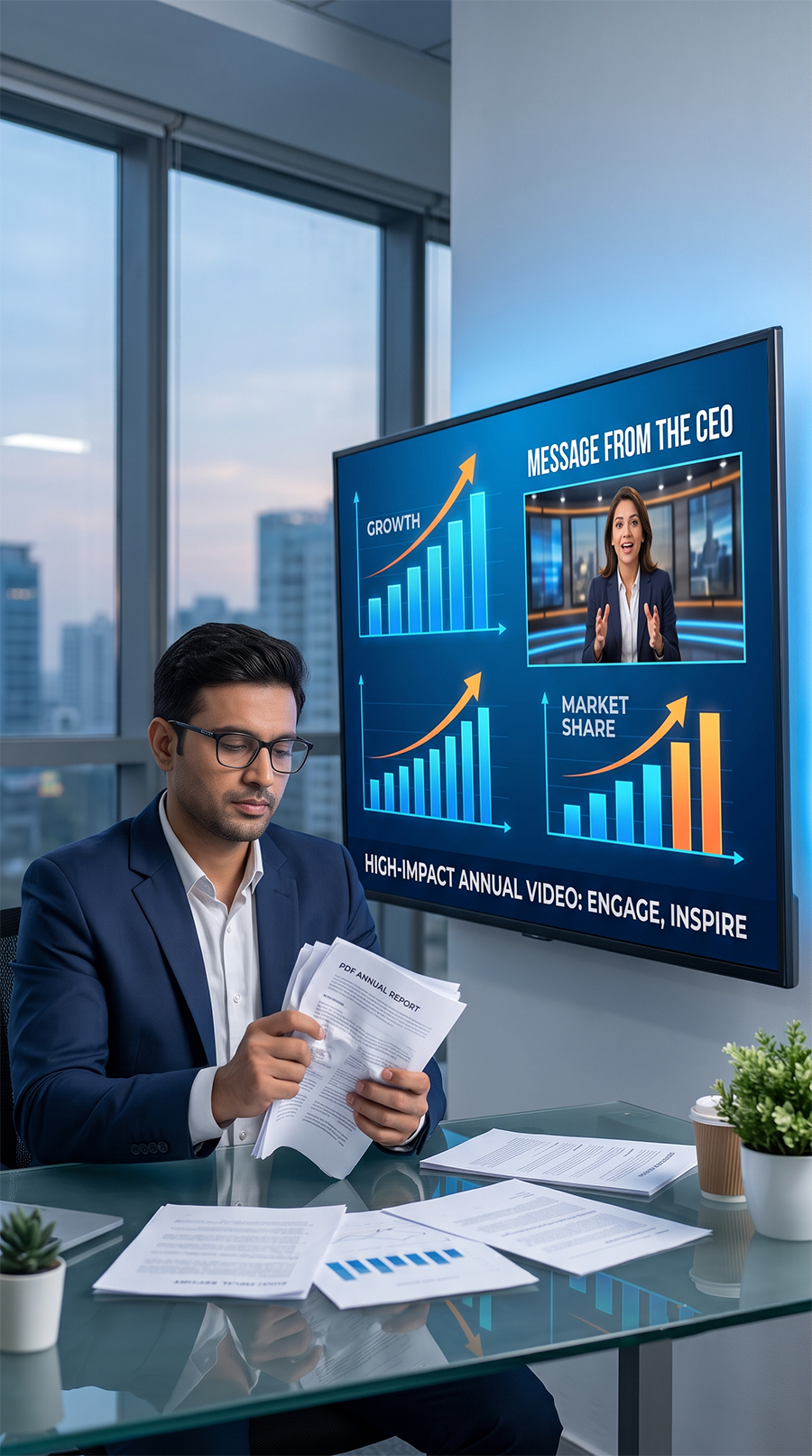
A corporate film changes the relationship. It does not replace the statutory report. It gives the report a voice, a pace, and a face. Suddenly the same numbers that sat in columns become sequences. A capacity increase is no longer a percentage; it is the camera moving down a new line. An ESG milestone is no longer a paragraph; it is a shift manager explaining what changed on the floor. A strategic bet is no longer a slide in the outlook section; it is the CEO looking into the lens and saying, without notes, what the next three years are actually for.
That is why companies that take their stakeholder relationships seriously are moving the annual story onto screen.
What changes when the year becomes a film
Engagement stops being a hope and becomes a design decision. Motion graphics can hold a complex P&L for twelve seconds and still feel clear. A well-cut interview can carry more conviction than a signed letter. A single four-minute film can be chaptered, clipped, subtitled, and sent into every channel the company already uses — investor site, AGM hall, press room, LinkedIn, internal town hall — without shooting twice.
Leadership becomes visible instead of merely quoted. Shareholders and lenders do not only want accuracy. They want to see that the people running the company can look at a camera and speak in complete sentences about risk, capital allocation, and the next cycle. Printed text cannot do that. A carefully directed interview can.
The operational reality of the business finally appears. Factory floors, new machinery, quality labs, dispatch yards, the ordinary dignity of a well-run shift — these are the images that tell industrial and manufacturing companies apart from companies that only have a website. A PDF cannot show that. A film can, if it is shot with patience instead of stock footage.
What the film is made of
The strongest annual-report films are not advertisements. They are structured like a short documentary with a clear spine:
- Opening: the year in one image and one line.
- Operations: real locations, real processes, real people at work.
- Numbers: motion graphics that respect the data instead of decorating it.
- Leadership: unhurried conversations with the people who signed the accounts.
- Outlook: a short, specific view of what comes next — not slogans.
Length is usually three to five minutes for the master cut. Everything else is derived from that master: a ninety-second investor cut, a thirty-second social cut, a silent version for screens at the AGM, a longer cut for the board if needed. One production, many lives.
Why this matters in places like Udyog Vihar, Sector 37, and Pace City
The companies that sit in these belts already know how to make things. The next advantage is how they talk about what they made. In a crowded B2B landscape, the firm that can put its year on screen with clarity and restraint looks like the firm that is already thinking like a listed, institutionally held business — even if it is still privately held. The PDF says “we complied.” The film says “we have a story, and we know how to tell it.”
That difference is small on paper and large in a room full of people who have seen a hundred other reports.
Cuts & Camera
We produce these films end to end: research and script, interview direction for promoters and CXOs who are not actors, motion graphics that treat financial data with respect, and a final cut that can sit next to broadcast work without apology.
If this year’s report is already closed, the film can still be made from what you have. If next year’s report is still being written, the film can be planned while the numbers are still moving.
7042111335
info@cutsncamera.in